重塑身体:
亚洲女性艺术家的赛博格叙事
Remaking the Body:
Cyborg Narratives of Asian Women Artists
2025 年的夏天,走进柏林汉堡火车站美术馆,观众会立刻被韩国艺术家 金雅瑛 的个展 “跨越多个世界” 带入沉浸式的科幻体验。五个展厅被充满未来感的深蓝色覆盖⸺昏暗的灯光、错落的镜面、冰冷的金属支架与折叠展开的影像幕墙交织成一座流动的建筑。声音与光线在空间中不断延伸与变形。镜像与屏幕共同营造的迷幻场域让观者分不清正置身于艺术舞台、科技实验室,还是被数据和代码建构出来的虚拟世界。此刻,人对于身体的感知开始变得悬浮,它既是行动与凝视的主体,又是被监控与操控的对象。
在这里,身体早已不再是自然的产物,而是由技术、算法和影像系统共同构成的混合体⸺一种典型的赛博格(cyborg)。自唐娜・哈拉维(Donna Haraway)在 20 世纪 80 年代通过《赛博格宣言》(A Cyborg Manifesto)对 “赛博格” 这一概念进行理论重构以来,这种混合体状态便成为思考人类与机器、性别与权力关系的重要隐喻。金雅瑛正是借由赛博格的视角,探索着当代社会中身体与技术共生的张力。
在 “跨越多个世界” 展览中,金雅瑛带领观众踏上穿越未来首尔的奇幻旅程,跟随两位女性外卖舞者在一系列交叠的平行世界中穿梭。在旅途中,艺术家提出了她的核心问题⸺一个与当下紧密共鸣的问题:当人的身体成为技术凝视和算法治理的对象,我们要如何理解操控、归属与自我认同的流动边界?女性与舞蹈的身体,能否成为抵抗数字异化的语言和实践?
In the summer of 2025, stepping into Berlin’s Hamburger Bahnhof, visitors are immediately immersed in the sci-fi universe of Korean artist Ayoung Kim’s solo exhibition “Many Worlds Over.” Five galleries are bathed in a deep, futuristic blue—dim lighting, staggered mirrors, cold metal scaffolds, and unfolding projection walls intertwining into a shifting architecture. Sound and light extend and transform throughout the space. The interplay of mirrors and screens disorients the viewers: is this an art stage, a tech laboratory, or a virtual world spun from data and code? In this moment, one’s sense of the body begins to hover—simultaneously the subject of action and gaze, and the object of surveillance and control.
Here, the body is no longer a natural given, but a hybrid forged by technologies, algorithms, and image systems—a quintessential cyborg. Since Donna Haraway’s theoretical rearticulation of the concept of the “cyborg” in the 1980s through A Cyborg Manifesto, the cyborg has served as a powerful metaphor for exploring the entanglements of human and machine, gender and power. Through this lens, Kim probes the tensions of a contemporary world where bodies and technologies exist in symbiosis.
In “Many Worlds Over,” Kim immerses viewers in a fantastical journey through a future Seoul, following two female delivery dancers as they move across a series of overlapping parallel worlds. Along the way, the artist poses her central question—one that resonates urgently with our present: when the body becomes the object of technological gaze and algorithmic governance, how can we navigate the shifting boundaries of control, belonging, and identity? Can women’s bodies—and the body of dance—serve as both a language and a practice of resistance against digital alienation?
金雅瑛的 “快递舞者” 系列包含了多个作品:《幽灵舞者 A》、《幽灵舞者 B》、《快递舞者模拟》、《快递舞者之域》与《快递舞者之弧:零度接收者》等。在这系列作品中,贯穿着两位在城市与异度空间里穿梭的女性快递员⸺在艺术家的构想中被视为 “快递舞者” 的 Ernst Mo 与 En Storm。她们名字的拼写正好是 “Monster” 的不同异序词。通过实景拍摄、CGI 与生成式 AI 的融合,金雅瑛构建出一则关于女性身体、算法治理与都市未来的寓言。在她构建的世界里,时间不是背景,而是一种可以被随意扭曲、拉伸和折叠的材料。1 外卖平台 “舞蹈大师” 是一个由算法驱动的外卖派单系统,它像编舞一样精确地调度着快递舞者的身体。通过等级、评分和冲榜等机制,“舞蹈大师” 把快递舞者的时间轨迹切割成极端精确的计量单位。时间是货币,也是敌人。2 快递舞者要生存,就必须不断奔跑,不断优化速度和效率,如同投入一场无穷无尽的闯关游戏。
金雅瑛提到,她关于多重世界的构想受到推想小说(Speculative Fiction)文学传统的启发。在这一维度上,她的创作路径可以说与非裔美国作家奥克塔维娅・巴特勒 “从现实向外推演” 的写法不谋而合。巴特勒的作品往往以极具社会寓言色彩的设定,延展出关于种族、性别、基因与权力的想象。而金雅瑛的目的也并不是去虚构一个酷炫的科幻世界,而是把首尔现实生活中的零工劳动、算法操纵,以及女性的身体困境推演成一种未来的预言。让观众逐渐意识到,这不是虚构的危机,而是正在迫近我们的现实。
Footnotes
Kim’s “Delivery Dancer” series includes Ghost Dancers A (2022), Ghost Dancers B (2022), Delivery Dancer Simulation (2022), Delivery Dancer’s Sphere (2022), and Delivery Dancer’s Arc: 0º Receiver (2024). Central to these works are two female delivery drivers, framed by the artist as delivery dancers—Ernst Mo and En Storm—who traverse the city and slip through dimensional rifts. Their names are anagrams of “Monster.” Blending live-action footage, CGI, and generative AI, Kim crafts a contemporary fable that interrogates women’s bodies, algorithmic governance, and the urban future. In Kim’s world, time is not a backdrop but a material to be twisted, stretched, and bent. 1The delivery platform “Dance Master” is an algorithmic dispatch system that choreographs its delivery dancers with precision. Through rankings, scores, and leaderboard competition, it slices their time into hyper-measured units. Time is a currency…time is the enemy.2 To survive, the delivery dancers must sprint endlessly, constantly optimizing speed and efficiency, as if trapped in an infinite, level-based game.
Kim notes that her conception of multiple worlds is shaped by the tradition of speculative fiction. From this perspective, her creative trajectory may be seen as converging with the methodology of African American writer Octavia E. Butler, who employs “extrapolating from reality” in her writing. Butler's works often extend imaginative explorations of race, gender, genetics, and power through richly allegorical social settings. Kim’s methodology echoes this approach: rather than constructing a flashy sci-fi universe, she projects the conditions already shaping life in Seoul—gig-work, algorithmic manipulation, and women’s embodied vulnerabilities—into a prophetic horizon. Viewers gradually come to realize that this is not a crisis of fiction, but one that is closing in on us.
Footnotes
金雅瑛把 “快递舞者” 系列作品的女主角命名为 “怪物”(Monster)的异序词,也是在暗示这两位女性虽然同样是系统中被异化的劳动者,但她们作为系统内部的 “故障”,也将会成为撕开现有秩序的希望。作为 “怪物” 的两个变体,Ernst Mo 和 En Storm 彼此映照,既相似又对立。她们代表的不是一个稳定的自我,而是在多重世界中游走,充满分裂与可能性的赛博格主体。1 她们以 “怪物” 的姿态反抗系统和算法的控制,试图创造另一种存在的逻辑。金雅瑛的这一构想与东亚语境下女性赛博格形象的演变,形成了一种跨越媒介和世代的对话。
Footnotes
-
除了推想小说,金雅瑛的灵感也来自数字时代的女性和酷儿网络文化,她坦言自己曾受到韩国 Webtoon(网络条漫)中 GL(Girls’ Love)叙事的影响,且非常希望能够把这些声音带到主流艺术世界的美术馆之中。这使得 Ernst Mo 与 En Storm 的关系不仅是竞争与角力,也具有酷儿的暧昧和亲密。当她们身体的对峙被凝固为雕塑时,抵抗的姿态又仿佛恋人之间的拥抱。 ↩
By naming her protagonists after anagrams of “Monster,” Kim signals that although these women are alienated laborers within the system, they also operate as its potential glitches—fissures through which a new order might emerge. As two mutant variants of the Monster, Ernst Mo and En Storm reflect and oppose one another. They do not embody a stable self, but a cyborg subjectivity that drifts across multiple worlds, marked by fracture and possibility. 1In their monstrous guise, they resist algorithmic control and strive to articulate alternative logics of existence. Kim’s vision resonates with the evolving figure of the female cyborg in East Asia, creating a dialogue that spans media and generations.
Footnotes
-
Beyond speculative fiction, Kim also draws inspiration from digital-era women and queer cultures. She has long been influenced by Korea’s GL (Girl’s Love) webtoons, and really wanted to bring those voices into some mainstream galleries in the art world. Thus, the relationship between Ernst Mo and En Storm is not only one of rivalry and contention but also of queer ambiguity and intimacy. When their bodily confrontations are cast into sculptural form, their postures of resistance evoke something akin to an embrace. ↩
自上世纪 90 年代中期起,日本动漫《攻壳机动队》中的主角草薙素子一直被视为女性赛博格的经典形象之一。草薙素子的原始人类身体几乎已经不复存在,除了意识本身,她的所有肢体和器官,包括大脑外壳全都是人工制造的。其义体具有超越普通人类的力量,可以与装甲车等重型武器正面对抗。义体可以被修理,升级,如同不断迭代的机械产品。然而,这一被高度军事化的赛博格,其外观又是一具充分符合主流男性审美的,高挑健美的女性身体。其凹凸有致的身材、近乎半裸的出场方式,满足了男性观众的欲望投射。草薙素子的赛博格设定揭示了一个悖论:女性固然可能因为赛博格化而被赋能,她们的身体却也可能始终处于制度和系统的控制和凝视之中。
Since the mid-1990s, Motoko Kusanagi from Ghost in the Shell has stood as one of the most iconic female cyborgs. Her original human body has nearly vanished; aside from her consciousness, every limb and organ—including the casing of her brain—is artificially constructed. Her cybernetic shell grants superhuman strength, capable of confronting armored vehicles head-on, and can be repaired, upgraded, and continually iterated like a piece of machinery. Yet this heavily militarized cyborg is rendered in a hyper-sexualized, idealized female form: tall, sculpted, and voluptuous, often appearing nearly nude, catering to the projections of the male gaze. Motoko embodies a paradox: cyborgization can empower women, yet their bodies remain trapped within regimes of systemic control, discipline, and spectacle.
金雅瑛也曾提到,在尝试用 AI 技术生成女性形象时,现有的模型往往受到现实社会中性别刻板印象与种族主义的影响,总会制造出一些令人不快的 “亚洲女性幻想” 式图像。1 这一经历让金雅瑛更明确地意识到,她所创造的亚裔赛博格女性形象不应是带有东方异域情调的欲望对象,而应该体现出现实中亚裔女性的劳动困境。“快递舞者” 系列中的两位主角没有草薙素子那样性感而完美的义体。金雅瑛为她们设计的服装也介于快递员制服与航空服之间⸺去性化的剪裁、关节处护具般的结构,都将其主体性锚定在劳动者的框架内,明确拒绝被审美化为欲望客体的风险。
无独有偶,近年来涌现出的一批韩国女性科幻作家(如金草叶、千先兰等)也逐渐将亚洲女性赛博格叙事编织进日常生活场景。她们笔下的未来世界,不再以军事博弈或末日求生为主线,而是转向更具体的家庭关系与情感纠葛。收录于金草叶短篇小说集《刚刚离开的世界》的作品《萝拉》便是极具代表性的例子。小说的女主人公萝拉在经历车祸后,时常会因为不存在的第三只手臂而感到剧痛。在接受虚拟实境疗法后,痛症缓解了,但萝拉觉得自己拥有第三只手臂的感觉却变得更强烈了。于是,萝拉决心安装一只机械手臂。萝拉的伴侣珍始终无法理解萝拉为何要为一条并不存在的手臂接受身体的改造,而萝拉则将身体的重塑视为找回自我的唯一方法。那条冰冷且带有汽油味的机械手臂,不仅是外在的义肢,更是情感裂缝的具象化呈现。在金草叶的叙述中,赛博格是一种情感装置,记录了人类在现代社会不断被异化的无措和痛感。赛博格化的女性身体在这里成为思考 “爱” 与 “他者性” 的媒介:如果爱意味着要去拥抱一个不可理解的他者,那么赛博格就象征着人和他者注定无法完全理解的必然性。
Footnotes
-
Sam Bardaouil,《我们支离破碎的生存状态恰是当下的生活条件》,载于《金雅瑛:跨越多个世界》(汉堡火车站美术馆展览图录,柏林,2025)。 ↩
Kim has also noted that when she experiments with generating female figures through AI, the models sometimes “spits out some quite unpleasant, biased images of Asian women” shaped by an “Asian fetish.” 1This experience reinforced her conviction that the Asian female cyborgs she creates must resist exoticization and instead reflect the real labor precarity faced by Asian women. Unlike Motoko, Ernst Mo and En Storm do not possess sleek, eroticized bodies. Their outfits—positioned between courier uniform and flight suit—are deliberately de-sexualized, with joint-like protective structures that anchor their subjectivity firmly within a laboring framework, explicitly rejecting the risk of being aestheticized as objects of desire.
Notably, a new generation of Korean women sci-fi writers—such as Kim Cho-yeop and Cheon Seon-ran—has begun to weave Asian female cyborg narratives into everyday life. Their imagined futures are no longer driven by militarized conflict or apocalyptic survival, but pivot toward the intimate dramas of family relations and emotional entanglements. The story “Lola” included in Kim Cho-yeop’s short story collection The World I Just Left exemplifies this shift: the protagonist, Lola, often experiences intense phantom limb pain from a nonexistent third arm following a car accident. After undergoing virtual reality therapy, the pain subsides, but Lola finds the sensation of having a third arm has become even stronger. Consequently, she resolves to have a mechanical arm installed. Her partner Jean cannot grasp why Lora would modify her body for a limb that does not exist, while for Lora, remaking her body is the only path back to herself. The cold, gasoline-scented mechanical arm becomes both an external prosthesis and a literalized emotional fissure. In Kim Cho-yeop’s narrative, the cyborg functions as an emotional apparatus, registering human bewilderment and pain under conditions of modern alienation. Here, the cyborg female body serves as a medium for contemplating love and otherness: if love entails embracing an other who cannot be fully understood, then the cyborg embodies the inevitable impossibility of ever truly knowing another.
Footnotes
-
Sam Bardaouil, Our Fractured Existences Are Simply Our Present Condition of Living, in Ayoung Kim: Many Worlds Over (Exhibition catalogue for Hamburger Bahnhof, Berlin, 2025). ↩
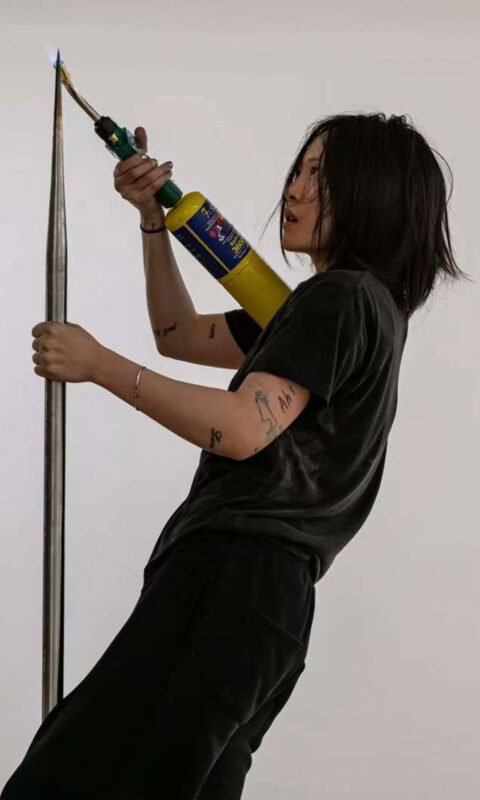
如果说《萝拉》描写了技术维度上的 “幻肢痛”,那么艺术家 王溪曼 的实践则将这一概念带回到身体创伤与修复的具体现实之中。在行为表演《仿佛暗示了它自己的修正》(2024) 中,艺术家将自己的身体化为赛博格的试验场:为了在 “健全” 的右腿上固定一条假石膏腿,她用钢针刺穿石膏绷带,扎进自己的小腿;同时卸下了 “残缺” 的左腿上的真正的义肢。王溪曼并没有使用机械义肢去延展或强化身体的机能,而是让身体和机械外物始终处于未完成的协商状态。具身性的痛感也成为了作品的焦点之一⸺幻肢不再是医学意义上的神经错觉,而是一种不断感知缺口和故障的存在状态。她的创作对 “健全身体” 这一概念本身提出了批判。
If Kim Cho-yeop’s “Lora” frames phantom limb pain through a technological lens, artist Wang Ximan brings it back to the material realities of bodily trauma and repair. In her performance As If It Suggests Its Own Corrections (2024), Wang transforms her body into a cyborg testing ground: to affix a mock cast onto her “intact” right leg, she drives steel needles through layers of plaster into her calf, while simultaneously removing the actual prosthesis from her “damaged” left leg. Rather than using prosthetics to extend or enhance the body, Wang keeps body and apparatus in a state of perpetual, unfinished negotiation. Pain becomes a central material of the work—phantom limbs are no longer neurological illusions but a lived experience of ongoing gaps and failures. Her practice mounts a critique of the very notion of a complete body.
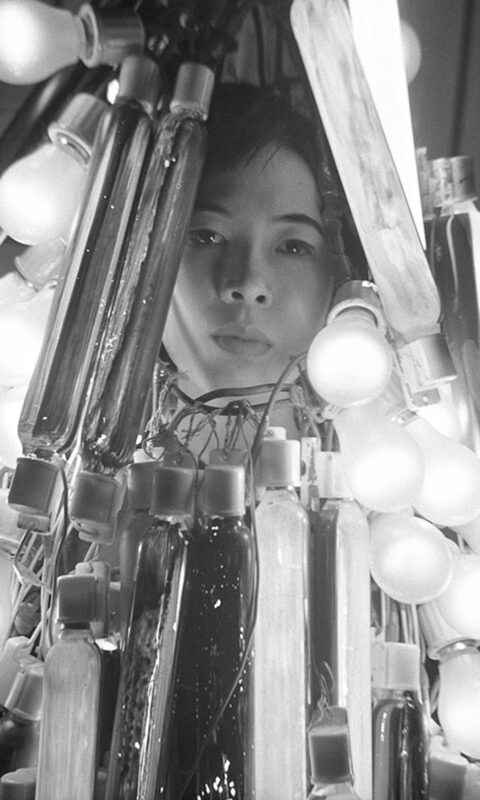
回顾历史,女性赛博格形象在亚洲女性创作者的实践中不断被重塑。其中一个早期的标志性例子,是日本艺术家 田中敦子 于 1956 年创作的《电气服》。这件由约两百个彩色灯泡、电线与控制台组成的服装,在电源接通时会将艺术家的身体点亮成一个发光的电路系统。从视觉上看,田中既是被电流与技术操控的载体,又是被点亮为能量与行动中心的主体,作品因此触及了女性身体在技术与权力系统中的位置问题。
田中创作《电气服》的 1950 年代正值日本战后重建与工业化的初期。电子产品与家用电器作为现代化的象征进入日常生活,技术进步被视为国家复兴的希望,却也强化了社会的性别分工。日本女性被期待成为电气化家庭中的现代主妇,成为机器与家务之间的接口。《电气服》正是在这一语境下诞生的。田中将身体嵌入一件密布电线的服装之中,主动进入技术系统:她既作为被接通与操控的身体存在,又作为导电、发光的行动主体显现。这种双重定位揭示了女性在技术社会中的张力:在被技术规训的同时,也在其中生成新的能动性。在这个层面上,《电气服》不仅预示了女性赛博格意象的萌芽,也开启了对女性身体在现代化进程中被电器化和工具化的反思。
Looking back, the figure of the female cyborg has been continually reimagined in the practices of Asian women artists. One early and emblematic example is Atsuko Tanaka’s Electric Dress (1956). Composed of wires, a control console, and roughly two hundred lightbulbs, the garment illuminates when powered, transforming the artist’s body into a radiant circuitry. Visually, Tanaka appears both as a conduit subject to electric currents and technological control, and as the glowing center of energy and action. The work thus foregrounds the complex position of the female body within systems of technology and power.
Tanaka’s Electric Dress, created in the 1950s, emerged amid Japan’s postwar reconstruction and the early wave of industrialization. Electronics and household appliances entered daily life as icons of modernity; technological progress was hailed as the nation’s promise of revival, yet it also reinforced entrenched gender roles. Japanese women were expected to become modern housewives in electrified homes, serving as the interface between machines and domestic labor. It was within this context that Electric Dress came into being. Tanaka draped her body in a garment densely threaded with wires, deliberately inserting herself into the technological system—both a body to be connected and deployed, and a subject that conducts electricity and radiates light. This dual positioning exposes the paradoxical condition of women in a technological society: disciplined and constrained by technology, yet simultaneously discovering new forms of agency within it. In this sense, Electric Dress not only anticipates the emergence of the female cyborg imagery but also opens a space to reflect on how women’s bodies are electrified and instrumentalized in the process of modernization.
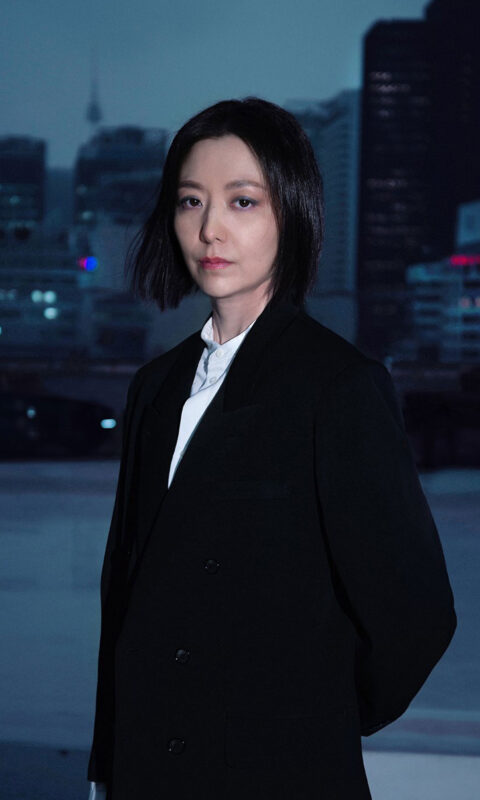
1978 年出生于广州的艺术家 曹斐,与中国的改革开放与经济腾飞几乎同步成长。其作品《亚洲一号》(2018)将目光投向高度自动化的物流场景。这部带有科幻感的剧情片在京东物流的 “亚洲一号” 仓库与分拣中心取景,构想了一个近未来的爱情寓言故事。影片中的工人和配送员不仅被机器人严密监控与调度,甚至连情绪状态也会被人工智能的评分体系捕捉与操控。影片呈现出一种冷峻的后人类工业空间:传送带上的包裹精准高效地传输和运转,工人的手腕上印着标准化的条码,人类的情感与欲望被纳入算法的逻辑,却又在缝隙里悄无声息地发生着错位与抵抗。
Born in GuangZhou in 1978, Cao Fei came of age alongside China’s Reform and Opening Up and its meteoric economic rise. Her film Asia One (2018) turns its gaze toward the highly automated world of logistics. Shot in JD Logistics’ “Asia One” warehouse and sorting center, this sci-fi–tinged narrative imagines a near-future allegorical love story. In the film, workers and couriers are not only tightly monitored and coordinated by robots, but even their emotional states are tracked and modulated by an AI scoring system. The film presents a stark, post-human industrial space: parcels glide efficiently along conveyor belts, workers’ wrists bear standardized barcodes, and human emotions and desires are subsumed into algorithmic logic—yet subtle misalignments and acts of resistance quietly emerge within the cracks.
《亚洲一号》将爱与情感的叙事植入智能物流的高度自动化场景里,使身体和亲密关系成为抵抗技术异化的途径。这样的设定使观众不得不去反思,在与算法逻辑和人工智能高度嵌合的劳动环境中,人类要如何继续产生情感,维系彼此之间的亲密和连接?曹斐对于情感与技术之间充满悖论的思考,与金雅瑛在 “快递舞者” 系列中对零工经济与算法治理的沈思形成了呼应。
韩国艺术家 郑锦衡 的创作则聚焦更加微观和具体的层面⸺观察人类身体与机械零件的互动,把人机关系拉回到最真实可感的触觉与力学之中。在她 2024 年的个展 “正在建造” 里,艺术家以 DIY 的机械零件与完整的人体骨骼模型拼装出形态奇异的 “骨骼机器”,并通过类似编舞的表演与它们展开亲密的互动。这些动作有时像是建造,有时像是拆解,也像是持续进行中的维修。郑锦衡揭示了机器与人类身体之间存在的暧昧地带:在互相接触磨合、彼此关照的过程中,它们将纠缠共舞在一起,并生出新的可能。
Asia One embeds narratives of love and affect into this hyper-automated environment, transforming bodies and intimate relations into sites of resistance against technological alienation. The work compels viewers to ask: in labor systems deeply entwined with algorithmic logic and AI, how can humans continue to feel, and sustain intimacy and connection? Cao Fei’s reflections on the paradoxes of emotion and technology resonate with Ayoung Kim’s contemplation of the gig economy and algorithmic governance in her “Delivery Dancer” series.
Korean artist Geumhyung Jeong’s work focuses on a more microscopic and concrete level, exploring the interplay between the human body and mechanical parts, and situating the human–machine relationship in the realm of touch and physical dynamics. In her 2024 solo exhibition “Under Construction,” she assembles uncanny “skeletal machines” from DIY mechanical components and complete human skeletons, and engages with them through choreography-like performances. These movements sometimes resemble construction, sometimes dismantling, and sometimes ongoing maintenance. Jeong highlights the ambiguous space between machines and the human body: through mutual adjustment and care, they entwine and dance together, opening up new possibilities.
无论是田中敦子让女性的身体接入电路的闪光时刻,曹斐在物流链条中构建出的爱情寓言,郑锦衡与机械骨骼充满创造性的编舞,还是金雅瑛笔下外卖舞者对算法治理的抵抗⸺这些艺术实践都在表明,科幻叙事并不是逃离现实,更是一种面向现实的批评工具。在这些女性艺术家的手中,科幻成为一个实验场。她们借由虚构的设定和异托邦的场景把现实中的权力结构、技术逻辑与性别政治推到极限,再从裂缝和故障的错位里想象新的可能性。女性身体不再只是被凝视与规训的对象,而是作为能创造能量和情感的主体得以呈现。科幻是一种创作的策略,它帮助女性艺术家们重新书写身体政治,探索身份认同的边界与可能,也拓展了我们关于归属与亲密的想象空间。(编辑:秋韵;翻译:郁祎)
Whether it is Tanaka’s luminous moment of the female body wired into a circuit, Cao Fei’s allegorical love story unfolding within logistics chains, Geumhyung Jeong’s inventive choreography with mechanical skeletons, or Ayoung Kim’s delivery dancers resisting algorithmic governance—these artistic practices demonstrate that science fiction is not an escape from reality, but a tool for critically engaging with it. In the hands of these women artists, science fiction becomes an experimental terrain. Through fictional constructs and heterotopian scenarios, they push power structures, technological logics, and gender politics to their limits, and from the resulting cracks and misalignments, they imagine new possibilities. The female body is no longer merely an object of gaze and discipline—it emerges as a subject capable of generating energy and affect. Science fiction functions as a creative strategy, allowing women artists to rewrite the politics of the body, probe the boundaries of identity, and expand our imagination of intimacy and belonging. (Editor: Ara Yun Qiu; Translator: Yi Yu)
相关艺术家
Related Artists
作者简介
AUTHOR’s biography
阿酌(b. 1992,临海),现居柏林,独立播客制作人及文学研究者,研究兴趣涵盖女性主义文学、移民与离散叙事、翻译与出版文化等领域。自2020年起,阿酌独立策划并制作中文文学播客《痴人之爱》,节目内容聚焦文学文本细读、跨文化对谈及性别视角下的文化观察。该播客全平台订阅量已超过十万,并持续推出城市主题系列节目,如“京都四季通信”、“柏林与流亡文学”等。
Azure Zhang (b. 1992, Linhai) is a Berlin-based independent podcast producer and literary researcher whose interests encompass feminist literature, migration and diaspora narratives as well as translation and publishing culture. Since 2020, Azure has independently curated and produced the Chinese-language literary podcast A Fool’s Love (痴人之爱), which focuses on close readings of literary texts, cross-cultural dialogues, and cultural observations from a gendered perspective. The podcast has reached over 100,000 subscribers across platforms and continues to produce city-themed series, such as Kyoto Seasonal Dispatches and Berlin and Exile.