重访“半边天”
Revisiting “Half of the Sky”
1996 年 2 月末,德国波恩艺术博物馆(Kunstmuseum Bonn)举行了一场名为 “中国!” 的绘画作品展,呈现了来自 31 位中国当代艺术家的 151 件作品⸺被认为首次于西方世界全面展示了中国青年画家的面貌 1。为筹备这个雄心勃勃的项目,展览主要组织者之一、时任波恩艺术博物馆馆长的迪特・罗特(Prof. Dr. Dieter Ronte)遍访了中国 8 个城市中的 200 间艺术家工作室,才最终敲定了艺术家名单。开幕式上,时任德国联邦总统的约翰内斯・劳(Johannes Rau)到场祝贺,并称该展览呼应了老子《道德经》中 “千里之行始于足下” 的思想,可作为德国观众了解现代中国的一次契机 2。
Footnotes
In late February of 1996, the exhibition “China!” opened at the Kunstmuseum Bonn in Germany, featuring 151 works from 31 contemporary Chinese artists. This exhibition is regarded as the first comprehensive showcase of young Chinese painters’ works in the West1. In preparation for this ambitious project, Prof. Dr. Dieter Ronte, then director of the Kunstmuseum Bonn and one of the main organizers of the show, visited 200 artists’ studios across eight cities in China, before finalizing the list of participants. Johannes Rau, then Federal President of Germany, attended the opening ceremony and remarked that the exhibition provided a perfect opportunity for German audiences to begin learning about modern China, quoting Laozi’s Tao Te Ching: “A journey of a thousand miles begins with a single step.”2
Footnotes
当然,并不是所有人都对这场展览感到满意,原因是 31 位参展的中国当代艺术家中竟没有一个是女性。1990 年代中期,第三波女权主义运动已经开始。受后结构主义、后殖民主义等理论的影响,此次运动在前几波女权思潮的基础上,进一步强调了女性群体内部在诸如种族、阶级、性取向、性别认同等方面的多元性。在两德统一后的数年间,德国妇女仍在积极争取合法堕胎权(尽管前东德妇女自 1972 年起就已享有该权利)。而北京则于 1995 年承办了举世瞩目的联合国第四次世界妇女大会,这场会议不仅标志着全球性别平等议程的一个重要里程碑 1,也成为了整个 90 年代女性主义在中国发展的高潮。
Footnotes
However, the exhibition was met with criticism, as none of the 31 contemporary Chinese artists featured were women. In the mid-1990s, the third wave of feminism, influenced by theories such as post-structuralism and post-colonialism, further emphasized the diversity among women by addressing race, class, sexual orientation, and gender identity, building on earlier feminist movements. In the years following German reunification, women in Germany actively fought for the legal right to abortion (though women in former East Germany had enjoyed this right since 1972). Beijing also hosted UN’s Fourth World Conference on Women in 1995, a major event that marked an important milestone in the advancement of global gender equality1 and a highlight in the development of feminism in China in the 1990s.
Footnotes
-
https://www.unwomen.org/en/how-we-work/intergovernmental-support/world-conferences-on-women, accessed August 9 2024. ↩
在这样的社会背景下,一个无女性艺术家参与(并称其原因是中国没有优秀的女性艺术家),却自诩代表中国当代艺术整体面貌的展览遭到众多德国女艺术家的抵制,也就不足为奇了。“中国!” 展览开幕不久,正值 “三八国际妇女节” 当天,一群德国女艺术家们集合起来举行了抗议活动。她们封锁了波恩艺术博物馆入口,并散发传单告诉观众这场展览对女性的拒斥及忽视,希望观众不要在妇女节前往观展 1。除了抗议行动外,几位波恩当地的女性艺术从业者更是决定组织一场展览予以回应⸺“半边天:中国女性艺术家” 展览的筹备工作自此启动。
Footnotes
-
克里斯・维尔纳(Chris Werner),“半边天”,《半边天:中国女性艺术家 》展览画册(波恩:妇女博物馆,1998 年)。 ↩
Against this backdrop, it is not surprising that this exhibition faced resistance from many German women artists. Although it aimed to provide an overview of contemporary Chinese art, it failed to include any female artists, and justified this omission by claiming that there were no outstanding female artists in China. Shortly after the opening of “China!”, a group of German women artists gathered to protest on International Women's Day. They blocked the entrance of the Kunstmuseum Bonn and distributed flyers informing the public of the exhibition’s exclusion and neglect of women, urging people not to visit the exhibition on this occasion 1. Moreover, several women from the Bonn art community decided to organize a separate exhibition in response, thus initiating the planning of the exhibition “Half of the Sky: Contemporary Chinese Women Artists.”
Footnotes
-
Chris Wermer, “The Half of the Sky: about this exhibition” in Half of the Sky: Contemporary Chinese Women Artists (Bonn: Frauenmusuem Bonn, 1998) ↩
“半边天” 展览核心筹备组由策展人克里斯・维尔纳(Chris Werner)、已定居德国多年的中国艺术家 邱萍(b.1961,武汉)和波恩妇女博物馆(Frauenmuseum Bonn)馆长玛丽安娜・皮岑(Marianne Pitzen)组成。几人于 1997 年、1998 年前往纽约、北京、上海、杭州等地进行考察,与许多中国女艺术家们面对面展开交流。而这段宝贵的经历,也被随行的电影导演、记者安妮莉・伦格(Annelie Runge)拍摄下来,最终制作成了一部 60 分钟的纪录片《中国女艺术家之旅:北京、上海、杭州》(Unterwegs zu chinesischen Künstlerinnen: Peking, Shanghai, Hangzhou)。
这是一次鲜少预设的旅行和调研⸺维尔纳和皮岑彼时对中国当代女性艺术家还相当陌生,而邱萍自 1988 年前往柏林艺术大学留学,也已阔别故土多年。因此,她们决定不限风格流派,首先广泛地接触、了解中国女艺术家的创作,列出一张全面多元的艺术家清单,再从中进行遴选。在扎实的走访与考察后,中国女性艺术家的装置艺术创作最终成为了 “半边天” 展览的聚焦所在。
The team behind “Half of the Sky” included curator Chris Werner, Chinese artist Qiu Ping (b. 1961, Wuhan), who had settled in Germany for many years, and Marianne Pitzen, director of the Frauenmuseum Bonn. During 1997 and 1998, they traveled to New York, Beijing, Shanghai, Hangzhou, and other cities to conduct research and meet with numerous Chinese women artists. Film director and journalist Annelie Runge, who accompanied them on the trips, captured valuable footages and created a 60-minute documentary, Unterwegs zu chinesischen Künstlerinnen: Peking, Shanghai, Hangzhou.
They did not know what to expect as they embarked on their journey. Werner and Pitzen were fairly unfamiliar with contemporary Chinese women artists at the time, and Qiu Ping had been away from her homeland for many years, since she left to study at Berlin University of the Arts in 1988. They therefore decided to explore a wide range of works by Chinese women artists without restrictions on style or genre, compiling a comprehensive list of artists before making final selections. After numerous visits and thorough investigations, they eventually chose installation art of Chinese women artists as the focal point of “Half of the Sky”.
此时此刻回看26年前“半边天”展出的作品,其整体所传达出的勇敢、凌厉、舒展的姿态,在当下渐趋保守的文化环境中令人怀念。而作品的观念、手法与意涵也可谓历久弥新⸺人与自然突破二元思维模式的融合;离散经历带来的限制与自由;女性作为主体、母职承担者的感受……
Looking back at the works exhibited in “Half of the Sky” 26 years ago, their boldness, fierceness, and expansiveness stand out even more against today’s increasingly conservative cultural climate. The concepts, techniques, and meanings of these works remain strikingly relevant. They examine topics such as the breakdown of humans-nature binary, the limitations and freedoms arising from diaspora, and women’s subjectivity and experiences of motherhood.
为什么是装置艺术?原因之一或许是相较于绘画,装置艺术少了许多历史包袱,更生猛自在,吸引了策展团队的注意。“装置艺术” 这一术语首次在西方被使用也仅仅是 1960 年代的事,而中国艺术家们的装置实验则开始于’85 新潮期间⸺一切都还刚刚萌芽,艺术家们的主体性于这一媒介创新中获得了巨大的解放。而或许正因为如此,装置艺术在中国官方展览场所的展出也往往一波三折,充满变数。据邱萍回忆,1998 年 3 月,她应邀参加在中国美术馆举办的 “世纪・女性” 展览。展览试图梳理中国女性艺术在二十世纪的发展脉络,分 “文献”、“藏品”、“外围” 三个部分展示,而装置艺术原定将呈现于 “外围” 单元,且展览场地并不在中国美术馆内⸺从中不难窥见装置艺术当时在中国艺术版图中的位置。然而,即便如此,就在邱萍已经从柏林到达北京准备布展时,展览场地突然生变,不敢冒险展示装置艺术,展览组织者只好再次展开斡旋与沟通 1。因此,中国女性艺术家的装置作品无疑正需要一个如 “半边天” 展览这样的舞台,而 “半边天” 也显然跳出了 “中国女性艺术家的作品是温婉柔美的” 这一刻板印象的框架(即便这种刻板印象在西方并不缺少受众),勇敢地呈现了这些充满实验性的作品。
Footnotes
-
邱萍,“相遇”,《半边天:中国女性艺术家 》展览画册(波恩:妇女博物馆,1998 年)。 ↩
Why installations? One reason may be that, compared to painting, installation art carries fewer historical burdens, thus making them appear more vibrant and freer, which captivated the curatorial team. The term “installation art” only came into use in the West in the 1960s, and Chinese artists started experimenting with installations during the ‘85 New Wave art movement. As an art form still in its infancy, installation art in China liberated artists creativity. Perhaps because of this, to display installation art in officially sanctioned venues in China often encountered challenges and uncertainties. As Qiu recalled, in March 1998, she was invited to participate in the “Century·Women” exhibition at the National Art Museum of China, which chronicled the artistic development of female Chinese artists in the twentieth century in three sections, “Archives”, “Collections”, and “Periphery”. Installation art was initially planned for the “Periphery” section, and the exhibition venue was not even located within the National Art Museum, a telling sign of its marginal status in the Chinese art landscape at the time. Just as Qiu had arrived in Beijing from Berlin to prepare for the installation, the venue was changed unexpectedly. The exhibition organizers, wary of the risks of showing installation art, had to conduct further negotiations and discussions 1. The installation art of Chinese women artists demanded a platform like “Half of the Sky” to gain visibility. Meanwhile, the exhibition challenged the prevalent Western stereotype of Chinese women’s art as gentle and delicate, and presented these experimental pieces with remarkable courage.
Footnotes
-
Qiu Ping, “Encounter: Experineces in East and West” in Half of the Sky: Contemporary Chinese Women Artists (Bonn: Frauenmusuem Bonn, 1998) ↩
最终有 26 位女艺术家入选参展名单⸺其中 19 位来自中国内地(包括北京、上海、杭州、湖北、天津等地),5 位散居于纽约、巴黎、柏林,2 位来自台北。性别在此成为一种纽带,穿越了由地缘政治塑造的壁垒。而女性在主流国族叙事中的边缘性,或许也在潜移默化中促成了这样的联结。因为预算有限 1,部分参展艺术家在布展期间借宿在本地德国人家中(还有一些则直接住在展厅里),也使这些 “联结” 变得更为具象可感。1998 年 6 月 10 日,“半边天” 展览终于在波恩妇女博物馆拉开帷幕⸺“中国没有优秀女性艺术家” 的论断也就不攻自破了。
此时此刻回看 26 年前 “半边天” 展出的作品,其整体所传达出的勇敢、凌厉、舒展的姿态,在当下渐趋保守的文化环境中令人怀念。而作品的观念、手法与意涵也可谓历久弥新⸺人与自然突破二元思维模式的融合;离散经历带来的限制与自由;女性作为主体、母职承担者的感受…… 可惜除展览画册之外,留存至今的图文资料都较为稀缺,笔者也只能从零星的档案与亲历者的口述中寻回吉光片羽。
Footnotes
-
波恩妇女博物馆馆长玛丽安娜・皮岑认为 “与某些不断涌现的,经费投入多达上百万马克的项目相比,妇女博物馆所得到的资金不过是热板上的一滴水罢了。” 见玛丽安娜・皮岑(Marianne Pitzen),“天空和大地”,《半边天:中国女性艺术家》展览画册(波恩:妇女博物馆,1998 年)。 ↩
Eventually, 26 female artists were selected for the exhibition. Among them, 19 came from mainland China (including Beijing, Shanghai, Hangzhou, Hubei, Tianjin, and other regions), 5 resided in New York, Paris, and Berlin, and 2 came from Taipei. As women remained marginalized in mainstream national narratives, their share female identity transcended geopolitical barriers, creating a sense of solidarity. Due to budget constraints, some artists stayed with local German families during the installation period, while others even slept in the exhibition galleries – an experience that further strengthened their bonds. On June 10 1998, “Half of the Sky” opened at Frauenmuseum Bonn, effectively challenging the claim that “there are no outstanding female artists in China.”
Looking back at the works exhibited in “Half of the Sky” 26 years ago, their boldness, fierceness, and expansiveness stand out even more against today’s increasingly conservative cultural climate. The concepts, techniques, and meanings of these works remain strikingly relevant. They examine topics such as the breakdown of humans-nature binary, the limitations and freedoms arising from diaspora, and women’s subjectivity and experiences of motherhood. Unfortunately, aside from the exhibition catalog, scarce visual and textual records have survived. I can only piece together a glimpse of the exhibition through limited archival sources and oral accounts from the participants.1
Footnotes
-
Marianne Pitzen, the director of the Frauenmusuem Bonn, believed that compared to some projects that keep emerging, with funding of up to millions of marks, the funding received by the Frauenmusuem was merely a drop in the bucket. See Marianne Pitzen, “Heaven and Earth” in Half of the Sky: Contemporary Chinese Women Artists (Bonn: Frauenmusuem Bonn, 1998) ↩
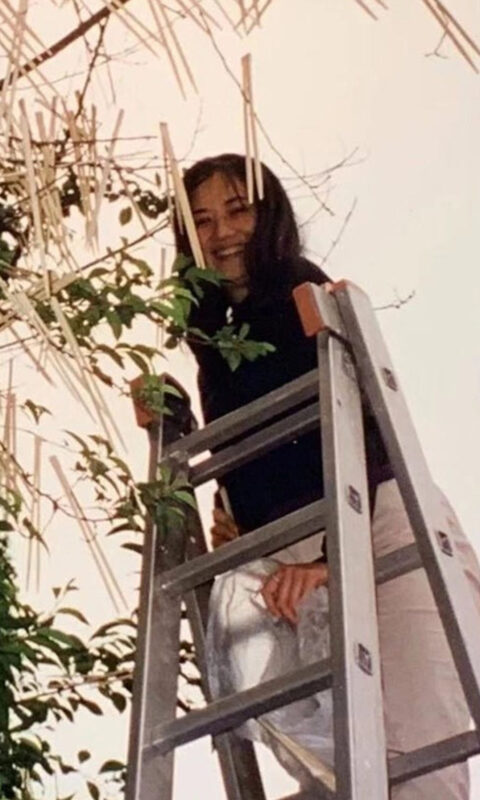
展览由 张蕾(b.1968,济南)的场域特定装置《自然的属性》开篇,艺术家将 4500 双一次性木筷子错落有致地 “夹” 在妇女博物馆内院的树枝上,使木材制作而成的餐具筷子 “回归” 自然的同时,也不落俗套地运用了这一饱含中国文化的符号⸺开门见山,预示着观众将会看到由中国艺术家们带来的作品。而联系到筷子古称为 “梜”,则更为作品平添了幽默与趣味。
The exhibition opened with Zhang Lei’s (b.1968, Jinan) site-specific installation Attributes of Nature. The artist carefully clipped 4,500 disposable wooden chopsticks onto the tree branches in the courtyard of the Frauenmuseum Bonn. The installation “returned” these wooden chopsticks back to nature, while creatively invoking a symbol of Chinese culture as a prelude to the works by Chinese artists. The installation also playfully references the character for chopsticks in ancient Chinese, 梜,which contains radicals meaning “wood” and “clip”.
另一件直接与当地自然环境产生互动的作品是 尹秀珍(b.1963,北京)的《洗河》。艺术家从莱茵河中提前取水,冻结成 140 余块坚冰,堆积在河岸边。1998 年 6 月 11 日,尹秀珍邀请在河畔散步的路人一道用清水清洗冰块,直至其融化。最终,如同筷子 “长” 回树梢,冰块也又重新汇入了河流。《洗河》是典型的社会参与式艺术(socially engaged art)实践⸺通过与当地人共创作品,初来乍到的中国艺术家巧妙地促成了本地社群与身边河流的亲密互动。而在现代社会作为自然资源被 “利用” 的河水借此享受了一番人类的清洗 “服务”。与此同时,这种耗时耗力,又往往徒劳无功、周而复始的清洁与擦洗对于熟悉家务的人(大部分是女性)来说可谓生活里最为平凡的经验之一。但也正是作品中蕴藏的日常性,帮助艺术家轻巧地渡过了文化间的沟壑。《自然的属性》与《洗河》中也蕴含着生态女性主义(Ecofeminism)的哲学⸺打破 “人–自然” 非此即彼的二元论思维方式,更进一步的是要打破这种思维方式中暗含的 “主宰–服从” 的统治关系。
Another work that engaged directly with the local environment is Yin Xiuzhen’s (b.1963, Beijing) Washing River. She drew water from the Rhine River, froze it into more than 140 blocks of ice, and then piled them on the riverbank. On June 11, 1998, Yin invited the passersby to wash the ice with water until they melted. Ultimately, just as the chopsticks “grew” back onto the trees, the ice returned to the river. Washing River is a typical example of socially engaged art. By co-creating the work with local residents, the newly arrived Chinese artist skillfully fostered an intimate relationship between the local community and their river. At the same time, the water from the river, often exploited as a natural resource in modern society, enjoyed a cleaning service from the humans. This time-consuming and labor-intensive act of cleaning and washing—often futile and repetitive—reflects one of the most common household chores, most of which are performed by women. Yet it is precisely this ordinariness of the work that helped the artist navigate the cultural differences smoothly. Both Attributes of Nature and Washing River also manifest ecofeminism ideas by challenging the binaries of human vs. nature and furthermore, the power dynamics of dominance vs. submission inherent in the binary framework.
“半边天” 展览中另一件以冰为媒介的作品《白费口舌》则传达出与《洗河》完全不同的讯息。作品初看上去是 9 只从墙面伸出的红色冰舌头(由可口可乐冻成),舌尖微微朝下,每只舌头下方都摆着一个金属痰盂。随着时间的流逝,冰舌逐渐融化,露出了里面藏着的尖刀。刀柄没入墙体,刀刃向上,充满了危险的气息。这件作品由 1990 年移居巴黎的 沈远(b.1959,仙游)创作。沈远追随先生黄永砅到法国后的最初几年,语言不通,对外交流受阻,便多从自身体验出发寻找创作灵感。《白费口舌》是她去国离乡后的第一件作品,其灵感就源于艺术家在外语环境里的敏锐体察⸺语言变得陌生后,有时便成为一种无意义的噪音,甚至变得锋利,犹如利刃可以伤人。沈远基于个人经历的创作,道出了离散者们共通的酸楚:当人们不得不割舍母语,远走他乡,苦涩和不安便会永远萦绕在舌尖。
如果说沈远启程时,还有亲人在巴黎迎接她的到来,那么 1988 年赴德求学的邱萍更是真正意义上的孑然一身⸺她带着母亲多年积蓄兑换的 40 美元,搭乘火车从北京只身前往柏林。十年过去,当邱萍作为 “半边天” 的参展艺术家及联合策展人组织这场展览时,她已在德国完成学业,成为了一名职业艺术家,同时也组建了家庭,成为了一名母亲。这些人生经历中饱含的甘苦,也成为了她的创作养料。邱萍在 “半边天” 中展出了装置作品《伞》⸺9 把明黄色沙滩伞在电动装置的控制下缓缓撑开、闭合,此起彼落。撑开时似向阳的花朵,收束时又似一把利剑。中间的一把伞被改造成小型喷水池,水池边缘围绕着一圈黄色的塑胶手套,好似迎接甘霖的花草。通过组合、改造现成品(沙滩伞、塑胶手套),邱萍传达了她对 “生命的开合” 的体悟。
除了《伞》这样略显抽象的作品,邱萍还在许多作品中具象地展现了人类的生殖性器官。尽管如此,作品并未试图唤起有关情欲的想象,而是通过呈现融合不同性征的生物一般,引发观者对性别之定义做一番冷静的观察与思考。当然,这并不代表在 “半边天” 展览中看不到对情欲的表达。正相反,有许多作品都涉及这一主题,但与众不同之处在于,这一次,情欲的主体是女人。还有许多作品涉及同样长期被消音的孕育生命、成为母亲的复杂感受。姜杰(b.1963,北京)在作品《卫生事故》中把婴儿状的小型人偶黏贴在挂历本的具体日期旁,这些日期被一个个 “X” 标记着,似乎克制地展现着月经与怀孕之间的张力。女性的月经既代表着孕育的能力,又代表着并未怀孕的状态;有些女性计算经期是为了拥有孕育的机会,有些则恰恰相反;有时怀孕带来的是喜悦与期待,有时则是一场令人心惊的 “卫生事故”。而 胡冰(b.1957,上海)的装置作品《怀孕–流产》则将怀孕与流产时女性的身体状态具象化:墙面上一只只塑料桶像鼓胀的腹部,其外包裹的铸造乳胶则如同被拉扯至极限的皮肤,而穿梭于塑料桶之间的电线犹如脐带,点亮了桶内新生命的光亮。整个装置就像一台赤裸的剖腹产手术⸺去除爱与浪漫的滤镜后,生育更像是发生在女性身体中的生死之战。
尽管无法在本文中历数 “半边天” 展览中的每一件作品,也必须承认有许多参展艺术家已不再活跃于人们的视野中,但这并不代表展览的价值与意义有所折损。本文写作于笔者环德旅行的路途中,当同行的各国朋友问起文章的内容,我都会略带自豪与惆怅地讲起 1998 年的故事。借此篇重温 26 年前波恩那个热烈的夏日,就如同女儿从母亲那里接过一束火炬,希望那炽焰再燃得久一些,传得远一些,在未来,照亮不仅仅是一半的天空。(翻译:赵文睿)
Another work in “Half of the Sky” that used ice as a medium is Perdre sa salive by Shen Yuan (b.1959, Xianyou). It conveys a completely different message from Washing River. The work appears to feature nine red ice tongues protruding from the wall, made from frozen Coca-Cola, with their tips slightly pointing downward. Beneath each tongue lies a metal spittoon. Over time, as the ice tongues gradually melt, sharp knives hidden within are revealed. It is a vista of danger: the knife handles are embedded in the wall, with the blades pointing upward. Shen moved to Paris in 1990, following her husband, Huang Yongping. In her first few years in France, she had great difficulty communicating with others due to language barriers, forcing her to seek inspiration from her own experiences. This is her first artwork after leaving her home country, inspired by her acute observations in a foreign language environment. Unfamiliar language can become meaningless noise or, at times, as sharp as a blade. Shen articulates the shared grievances of the diasporic community that when one has to abandon their mother tongue and venture into foreign lands, poignancy and unease often linger at the tip of their tongue.
While Shen Yuan was welcomed by her family upon arrival in Paris, Qiu Ping set off alone when she traveled to Germany in 1988 to study. She brought with her $40, converted from her mother’s years of savings, and traveled by train from Beijing to Berlin. A decade later, when Qiu organized “Half of the Sky” as a participating artist and co-curator, she had completed her studies in Germany, established herself professionally, built a family, and become a mother. The sweetness and bitterness of these life experiences fueled her creative work. Her installation at the exhibition, Umbrella, shows nine bright yellow beach umbrellas that slowly open and close, controlled by an electric device. When open, they look like flowers reaching for the sun; when folded, they evoke sharp swords. The umbrella in the center is transformed into a small fountain, surrounded by a circle of yellow rubber gloves, resembling flowers eagerly awaiting rain. Via the combination and transformation of ready-made items, such as beach umbrellas and rubber gloves, Qiu conveys her insights about life’s ups and downs.
In addition to more abstract works like Umbrella, Qiu also depicted human reproductive organs figuratively in many of her pieces. These works do not attempt to evoke erotic imaginings, but to prompt viewers to observe and reflect on the definitions of gender through hybrid biological forms. This does not mean that expressions of desire are absent from “Half of the Sky”. In fact, many works address desire, yet here, the distinction is that it is woman who desires. What’s more, several works explore the complex feelings surrounding pregnancy and motherhood, commonly invisible and silenced. InJiang Jie (b.1963, Beijing)’s piece Health Mishaps, she glued small infant-like figures next to specific dates on a calendar, each marked with an “X,” showing subtly the tension between menstruation and pregnancy. Menstruation can signify both the potential for conception and the absence of pregnancy. Some women track their cycles in hopes of conceiving, while others do so for the opposite reason. Sometimes pregnancy brings joy and anticipation, yet at other times, it can be a shocking “health mishaps”. Another installation, The Pregnant and Aborted by Hu Bing (b. 1957, Shanghai), materializes the physicality of pregnancy and miscarriage. Plastic barrels resembling swollen bellies on the wall are covered with latex, which appears like taut skin stretched to its limits. The wires weaving between the barrels are like umbilical cords, illuminating the new life within. The entire installation resembles a raw cesarean section. When love and romance are stripped away, childbirth is reduced to a life-and-death struggle within a woman’s body.
It is impossible to recount every work from the exhibition “Half of the Sky” in this article. Many participating artists are no longer active in the public eye, but this does not diminish the exhibition’s value and significance. As I wrote this article during my travels around Germany, I found myself sharing this story of 1998 with my travel partners from various nations with a sense of pride and melancholy. Revisiting that exciting summer in Bonn 26 years ago feels like receiving a torch passed from mother to daughter, hoping the flame will burn a little longer and travel a little farther, illuminating more than half of the sky in the future. (Translated by Zhao Wenrui)
特别感谢邱萍、黄凤祝博士对本文的帮助。
Special thanks to Qiu Ping and Dr. Huang Fengzhu for their assistance with this article.
相关艺术家
Related Artists
作者简介
AUTHOR’s biography
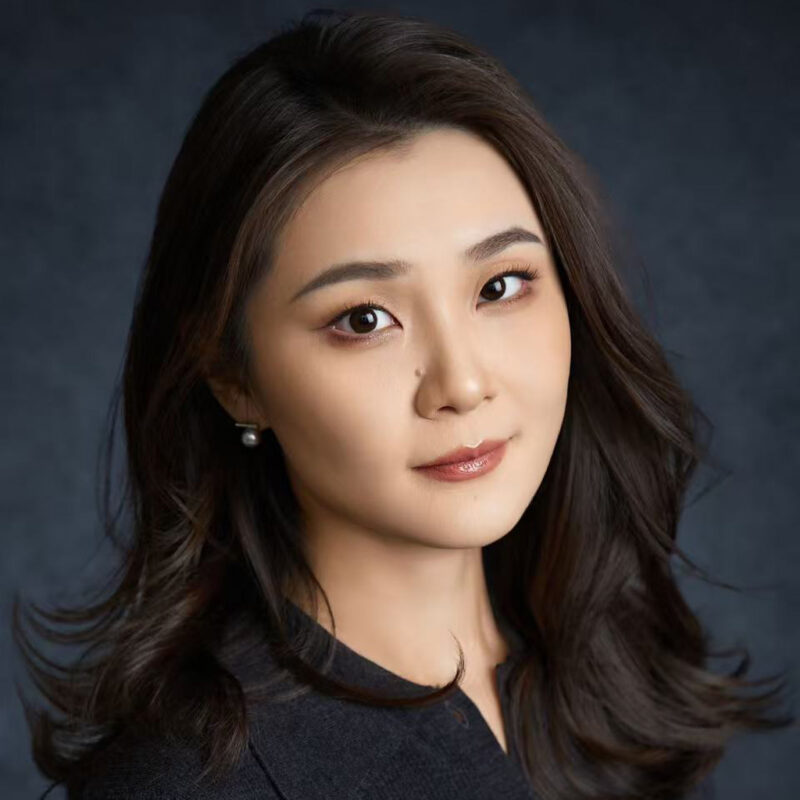
秋韵,独立策展人、写作者、研究者,长期关注女性艺术家的当代实践及历史叙事,现生活工作于柏林。
秋韵发起的「灰质」小组获选为 2022/23 年度 M+“希克中国艺术研究资助计划” 研究学人,她亦是 2023/24 年度德国总理奖学金获得者。曾担任 UCCA 尤伦斯当代艺术中心展览部副总监及策展人(2019–2022),乔空间(2017–2018)、龙美术馆(2015–2017)策展人,并深度参与了 UCCA Edge(上海)、上海油罐艺术中心的筹建工作。她在国内外策划组织超过十五场展览,包括 “托马斯・迪曼德:历史的结舌”(UCCA Edge,2022)、“非物质/再物质:计算机艺术简史”(UCCA Beijing,2020–2021)、“沉睡者的抵抗”(UCCA Dune,2020)、“李爽:如果云知道”(纽约,2018)等。
秋韵曾担任 2021 年华宇青年奖初评评委,2018 年纽约 Residency Unlimited 驻留策展人,其写作见诸于《M + 杂志》、《艺术界 LEAP》、《艺术新闻》、《艺术世界》等刊物。她 2012 年本科毕业于中国传媒大学电视与新闻学院,2014 年硕士毕业于纽约大学 Tisch 艺术学院艺术政治专业。
Yun Qiu (Ara) is an independent curator, writer, and researcher currently based in Berlin, with a longstanding focus on the contemporary practices and historical narratives of women artists.
Qiu initiated the research group “Grey Matter”, which is the awarded fellow of the M+ Sigg Fellowship for Chinese Art Research 2022/23. She is also a 2023/24 recipient of the German Chancellor Fellowship. Qiu was the Deputy Director of Exhibitions and Curator at UCCA Center for Contemporary Art (2019–2022). Before this role, she was a curator at Qiao Space (2017–2018) and Long Museum (2015–2017). Qiu was deeply involved in preparing and opening UCCA Edge (Shanghai) and TANK SHANGHAI. Qiu has curated and organized over 15 exhibitions, including “Thomas Demand: The Stutter of History” (UCCA Edge, 2022); “Immaterial/Re-material: A Brief History of Computing Art” (UCCA Beijing, 2020–2021); “Resistance of the Sleepers” (UCCA Dune, 2020); and “Li Shuang: If Only the Cloud Knows” (New York City, 2018), among others.
Qiu served as a shortlist jury member for the Huayu Youth Award in 2021 and completed a curatorial residency at Residency Unlimited in New York in 2018. Her writing has appeared in publications such as M+ Magazine, LEAP, The Art Journal, and Art World. She earned her undergraduate degree in 2012 from the School of Television and Journalism at the Communication University of China, and her master’s in Arts Politics from the Tisch School of the Arts at New York University in 2014.